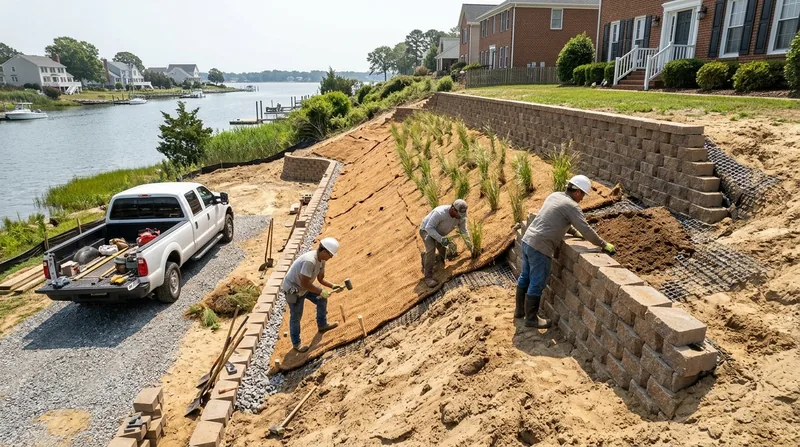




Slope Stabilization & Erosion Control in Virginia Beach
If your yard is sliding toward a tidal creek, your bank is caving behind the house, or rain keeps carving a gully across the lawn, you need slope stabilization and erosion control in Virginia Beach. This is flat Coastal Plain country, but it is not stable ground. Sandy loam and old dune sand sit on soft marine clay, the water table is only a few feet down, and the Lynnhaven River, the canals and the tidal creeks push salt water deep into Great Neck, Bay Colony and the North End. When a nor'easter dumps four inches in a day, that saturated sand moves. We build terraced walls, set geogrid, and install drainage and erosion control that hold the bank in place and keep your house, driveway and pool deck where they belong. If a wall is already leaning or has dropped a course, start with leaning and collapsed wall repair before the bank takes the rest of it.
Why Virginia Beach Banks Fail: Saturated Sand, Not Steep Hills
Most of the slope failures we see here are not on big hills. They are on six-foot banks above the inlets and on built-up lots where the yard steps up three or four feet to a patio. The failure mode that dominates in this city is a saturated sand slope giving way after heavy rain and tidal flooding, not a slow mountain creep. Old timber and railroad tie walls that have held for 30 years rot out and let the sand behind them wash downhill.
- Hurricane and nor'easter rain soaks the sand until it loses bearing capacity and the footing under an old wall washes out.
- Tidal flooding from the Lynnhaven and the canals saturates the bank from the bottom up, which is the opposite of how inland slopes fail.
- 1960s to 1980s timber edging in Kempsville, Thalia and Pembroke has rotted to the point where it holds nothing back.
- Downspouts and pool overflows dump water straight onto the bank and cut a channel in a single season.
- Great Neck and Bay Colony waterfront bluffs lose soil every time a storm surge pulls the toe out from under them.
Every one of these problems is fixable, but the fix has to address water first and wall second.
Key info: In Thalia and Kempsville we routinely find railroad tie walls holding back saturated sand with no gravel, no filter fabric and no weep holes. The ties look fine on the face and are hollow behind. That wall is not a wall, it is a dam, and it fails all at once after a heavy rain.
Before you spend a dollar on materials, check what your city requires. The Virginia Beach Planning and Building Department is the authority on permits, setbacks and when engineered drawings are needed for a wall on your lot.
How We Stabilize a Virginia Beach Slope, Step by Step
We do not guess at a bank. We walk the lot, look at where the water is coming from, and probe the soil to find the clay layer under the sand. Then we design a fix that drains the slope, reinforces it and holds the soil with a wall built for the load it actually carries. On a waterfront bank in Great Neck, that usually means a terraced design, not one tall wall.
- We walk the bank and map the drainage, including downspouts, pool overflow, grade and tidal reach.
- We probe the soil to find the sand depth and the marine clay below it, which sets the footing depth.
- We clear the failed timber or tie wall and remove the saturated soil behind it.
- We install drainage stone, filter fabric and perforated pipe at the footing to move water out and away.
- We set geogrid in lifts behind the wall so the sand and the wall act as one mass.
- We build the wall in block, poured concrete or boulder, terraced where the bank is tall.
- We restore the grade, seed or sod the slope, and check that water runs off the property, not into the bank.
On a Great Neck bluff above the inlet, that sequence is the difference between a wall that survives the next nor'easter and one that leans by spring.
Key info: A Bay Colony homeowner had a 40-foot bank above the inlet losing about a foot of soil a year. We terraced it with two block walls, set geogrid in the upper lift and ran the footing drain to a daylight outlet. The bank stopped moving and the patio above it stayed level through the next storm season. See how we handle this on the 23452 service page.
Stabilization and Erosion Control Methods We Use in Virginia Beach
The right method depends on bank height, soil, water and what sits above the slope. A low garden bank behind a Kempsville ranch does not need the same build as a waterfront bluff in Bay Colony. This table shows the approaches we use and where each one fits.
| Approach | Description | Best for |
|---|---|---|
| Terraced block walls | Two or more segmental block walls stepped up the bank with geogrid in each lift. | Tall waterfront banks and built-up lots with a patio or pool above. |
| Geogrid reinforcement | Grid layers tie the wall to the soil mass behind it so the slope acts as one unit. | Any wall over about 4 feet, and every wall carrying a surcharge. |
| Footing drainage and weep holes | Gravel, filter fabric and perforated pipe move groundwater out instead of letting it push. | Every bank in this city, because the water table sits only a few feet down. |
| Boulder toe and riprap | Natural stone at the base of the bank absorbs wave and current energy from tidal creeks. | Inlet and canal frontage where the tide pulls at the toe of the slope. |
| Surface erosion control | Regrading, seeding, sod and downspout routing keep rain from cutting channels. | Low banks and lawns where the soil is moving but no wall is needed yet. |
Most jobs combine two or three of these, and the combination is what actually holds the bank.
Slope Stabilization & Erosion Control Cost in Virginia Beach: What to Expect
We start every job with a free estimate, because a number without seeing the bank is a guess. On a simple low lawn bank, a surface fix with regrading and drainage can run a few thousand dollars. A terraced block wall with geogrid on a tall waterfront bank in Great Neck or Bay Colony is a much larger project, and the price reflects the engineering, the excavation and the access.
What moves the price most: bank height and length, how saturated the soil is, whether the wall carries a driveway or structure, access for equipment, how much old timber or tie wall has to come out, and whether the tide limits your work window. On the North End, a narrow lot between two beach cottages can cost more than a wide open bank in Chesapeake simply because a machine cannot get in.
Get two or three estimates and compare the scope, not just the total. A low bid that skips geogrid or footing drainage is not a cheaper wall, it is a wall you will replace. Our pricing page lays out the ranges in more detail.
Hiring a Retaining Wall Contractor Near Me in Virginia Beach
Slope work is structural work, so treat the hire like a structural hire. Ask how many walls of this height they have built on this kind of soil, and ask for references you can actually call.
Ask who pulls the permit. In Virginia Beach, a permit is commonly required for walls above roughly 4 feet measured from the footing, or when the wall supports a surcharge like a driveway or structure, and tall or tiered walls may need engineered drawings. Thresholds vary, so confirm with the building department for your address. If your lot is in an HOA, get the architectural approval in writing before the first block goes down.
Finally, get the drainage plan in writing. A contractor who cannot explain where the water goes is not stabilizing your slope. Reach us through the contact page and we will walk the bank with you.
Slope Stabilization & Erosion Control in Virginia Beach: Pricing Guide
| Service | Price | Details |
|---|---|---|
| Surface erosion control and regrading | Free estimate | Includes regrading, seeding and downspout routing; bank length and access move the price. |
| Low bank stabilization | Starting at $2,500 | Covers drainage stone, filter fabric and a low wall; height and old wall removal raise it. |
| Terraced block wall with geogrid | On estimate | Needs an on-site look for bank height, soil saturation and surcharge above the wall. |
| Boulder toe and riprap | On estimate | Priced by linear feet and stone size; tidal access and slope pitch change the figure. |
| Travel | Included | In Virginia Beach and surrounding areas, no separate call-out or mileage fee. |
| Estimate | Free | Response within 24h at (757) 579-1955, no obligation to book. |
Indicative pricing, the exact cost depends on square footage, finish, and site access. Free personalized estimate within 24h at (757) 579-1955.


