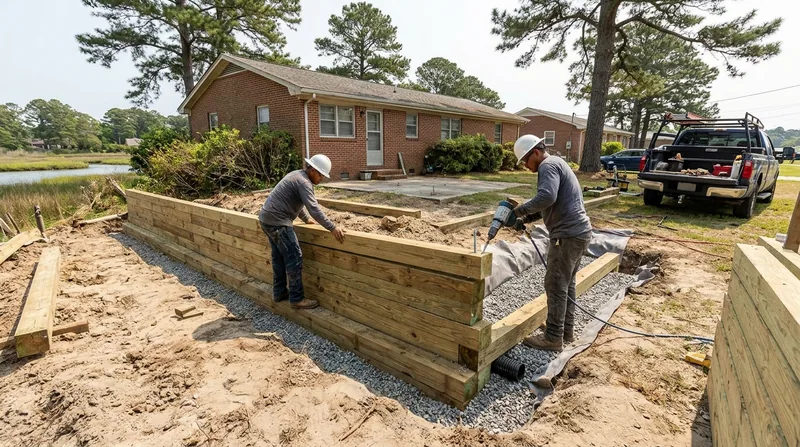




Virginia Beach sits on low, flat Coastal Plain ground, sandy loam and old dune sand over soft marine clay, with the water table only a few feet down. Tidal creeks, canals and the Lynnhaven River reach deep into neighborhoods, so a wall that looks fine in July can be leaning by February. If you are weighing Timber Retaining Walls in Virginia Beach, the honest answer depends on the ground under them, not just the price tag. Pressure-treated timber is a budget-friendly way to hold a garden bed or a low terrace, and we build plenty of them. We also tear out plenty that rotted from the bottom up in saturated sand. This page covers where timber makes sense here, what it costs, and when a longer-lasting material is the better call. For a broader look at wall types, see our retaining wall installation page.
Why Timber Walls Fail Fast in Virginia Beach's Wet, Sandy Ground
Most walls here do not fail because a hill pushes them over. They fail because water gets behind them and will not leave. Sandy loam drains quickly until it is saturated, then it behaves like a slurry against the back of the wall. The soft marine clay below holds that water, and the high water table gives it nowhere to go. Old landscape timber and railroad tie walls in Kempsville, Thalia and Pembroke are the classic casualties: the bottom course stays wet year-round and rots out first, then the wall leans and the top drops.
- Hurricane and nor'easter rain saturates the backfill and adds hundreds of pounds of pressure per linear foot.
- Tidal flooding and washouts along the Lynnhaven River and the canals undermine footings from below.
- Untreated or poorly drained timber rots at the soil line within 8 to 12 years in this climate.
- Tie walls without gravel and drain pipe trap water and fail years before the wood itself gives out.
- Walls built too close to a property line in Great Neck and Bay Colony leave no room for proper drainage.
We inspect the soil, the water table and the drainage path before we quote a timber wall, because those three things decide whether it lasts 10 years or 25.
Key info: A 3-foot timber wall on a dry Kempsville lot is a reasonable buy. The same wall on a tidal creek lot off Shore Drive, where the water table sits 18 inches down, needs gravel, filter fabric and a drain pipe or it will rot from the base up. We tell you which one you have before you sign anything.
Permits for walls above roughly 4 feet, or walls that carry a driveway or structure, go through the City of Virginia Beach building department, and thresholds vary, so verify before you dig. The City of Virginia Beach official site is the starting point for permit questions.
How We Build a Timber Wall That Survives a Virginia Beach Summer
We do not drop timber on sand and walk away. The build starts with the water, not the wood. We dig to stable soil, set a compacted gravel base, and build the drainage in as we stack. Every wall we build here gets a gravel backfill zone and filter fabric so sand does not clog the stone. Where the water table is high, we add a perforated drain pipe that carries water to daylight or a dry well. Then we set the timber, pin it, and backfill in lifts.
- We mark the wall line and call 811 so utilities are located before any digging starts.
- We excavate to firm soil and compact a gravel footing base, deeper on soft clay lots.
- We set the first course level and pin it, because a timber wall is only as good as its base.
- We install filter fabric, clean gravel and a perforated drain pipe behind the wall.
- We stack and pin each course with proper setback, then backfill and compact in lifts.
- We cap the wall, grade the soil behind it, and walk you through the drainage outlets.
That sequence is what separates a wall that holds from one that leans in three seasons.
Key info: On a recent job in the 23452 zip code, a homeowner had a 40-foot landscape timber bed wall that had dropped 4 inches at one end. The timber was still sound, but the footing had washed out where a downspout dumped onto the bed. We reset the base, added drainage and reused the good lumber. Full details are on our Timber Retaining Walls in Virginia Beach (23452) page.
Timber Wall Options We Use in Virginia Beach
Not every timber wall is the same product. The lumber, the treatment, the tie-back method and the drainage all change with the height and the load behind the wall. Here is how we match the approach to the job.
| Approach | Description | Best for |
|---|---|---|
| Pressure-treated landscape timber | 4x4 or 6x6 ground-contact lumber, pinned and stacked with gravel backfill. | Garden beds and low terraces under 3 feet. |
| Timber with deadman tie-backs | Timbers anchored back into stable soil with buried deadmen and gravel. | Walls 3 to 4 feet holding a patio or slope. |
| Timber over block base | A concrete or block footing course under the timber to beat the water table. | Tidal creek and canal lots with high groundwater. |
| Railroad tie wall replacement | Tear out of failed ties and rebuild with new timber or a longer-lasting material. | 1960s to 1980s ranch lots in Thalia and Pembroke. |
If your existing wall is already leaning, do not wait for the next nor'easter. Our leaning and collapsed wall repair page covers what we can save and what has to come out.
Timber Retaining Walls Cost in Virginia Beach: What to Expect
Timber is the budget option, and that is exactly why it is popular on garden beds and low terraces around Virginia Beach. Expect pricing to start from $20 per square foot for a straightforward pressure-treated timber wall with proper gravel backfill and drainage. That number moves with height, access, soil conditions and how much old material has to come out. A wall on a tight Great Neck waterfront lot with a narrow side yard costs more per foot than an open Kempsville backyard, because we hand-carry material and dig around established trees.
Three things drive the price more than anything else. Height and load: a 2-foot bed wall is a different job than a 4-foot wall holding a patio. Water: high groundwater means a block base, more gravel and a drain pipe. Removal: old railroad ties and rotted timber have to be pulled, hauled and disposed of, and that is real labor. Get two or three written estimates on the same scope so you compare like with like. Our full pricing overview breaks down how we build a number.
Timber Retaining Walls Near Me: What to Check Before You Hire in Virginia Beach
Anyone with a truck can stack timber. The difference shows up two winters later. Before you hire a contractor near Virginia Beach, check that they carry a Virginia contractor license and liability insurance, and ask for a certificate you can verify. Get at least three estimates in writing with the same scope, including drainage and disposal. Ask for references from walls they built at least five years ago in similar soil, not just last month's job. If your lot is in an HOA or near a protected tree or wetland buffer, confirm the rules before work starts. Our contact page is the fastest way to get a free estimate and a straight answer on whether timber is right for your wall.
Timber Retaining Walls in Virginia Beach: Pricing Guide
| Service | Price | Details |
|---|---|---|
| Low garden bed wall under 3 feet | Starting at $20/sq ft | Pressure-treated timber, gravel backfill, filter fabric and pinned courses included. |
| Terrace or patio wall 3 to 4 feet | Starting at $32/sq ft | Includes deadman tie-backs, deeper base and perforated drain pipe behind the wall. |
| Tidal or high water table lot | Starting at $40/sq ft | Block footing course and heavier drainage added where groundwater sits close to grade. |
| Railroad tie or rotted timber removal | On estimate | Haul-off and disposal priced after we see access, old tie condition and volume. |
| Travel | Included | In Virginia Beach and surrounding areas, no separate call-out or mileage fee. |
| Estimate | Free | Response within 24h at (757) 579-1955, no obligation to book. |
Indicative pricing, the exact cost depends on square footage, finish, and site access. Free personalized estimate within 24h at (757) 579-1955.


