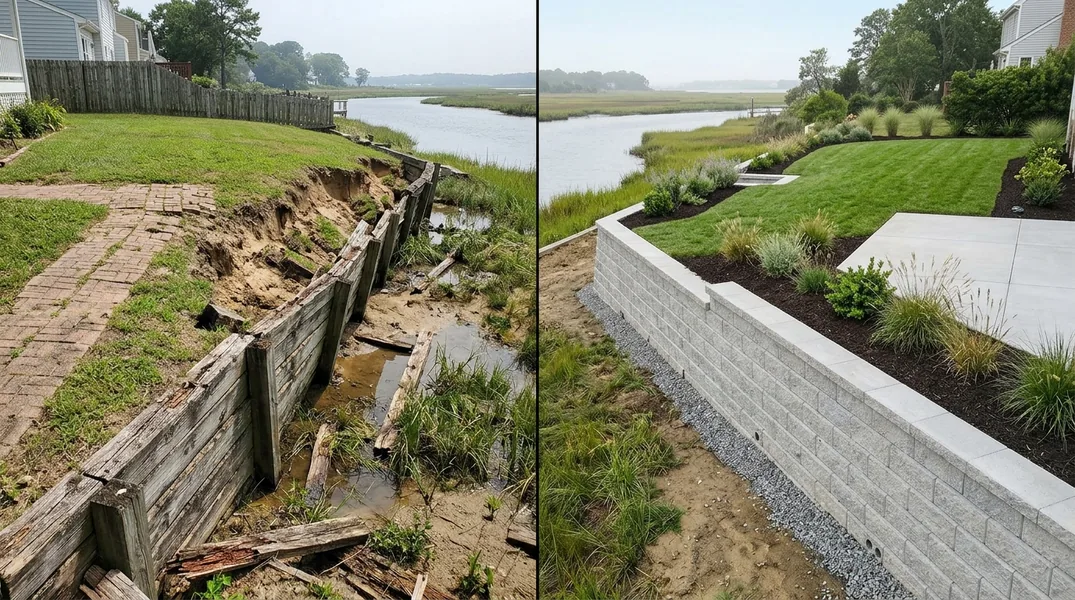
Why Sandy Soil and a High Water Table Change Everything
If you live in Virginia Beach, you already know that the ground here is not like the ground in Richmond or the mountains. Our coastal plain is dominated by deep sandy soils, and in many neighborhoods the water table sits surprisingly close to the surface, sometimes just a couple of feet down. That combination is a real challenge for any retaining wall, because sand drains quickly but it also shifts easily, and a high water table means hydrostatic pressure can build up behind a wall after heavy rain or during a nor'easter.
What that means for you as a homeowner is simple: the material you choose has to handle movement, moisture, and the freeze-thaw cycles we get in Hampton Roads. A wall that looks great in a dry climate may crack, lean, or settle here within a few seasons. The good news is that several proven materials work well in our conditions, and the right one depends on the height of your wall, the load it carries, your budget, and how you want it to look. Below we break down the four most common choices we install for local homeowners and explain where each one shines.
Concrete Retaining Walls: Strength for Demanding Sites
Concrete Retaining Walls are the heavyweights of the category, and they are often the best answer when a wall needs to hold back a significant load or protect a structure. Poured concrete gives you a solid, engineered mass that resists the lateral pressure that sandy, waterlogged soil can create. For taller walls, walls supporting a driveway or pool deck, or walls that need to double as a property boundary, concrete is hard to beat. It is also a low-maintenance choice once it is properly sealed, and it can be finished with textures or stains so it does not have to look like a plain gray slab.
The tradeoff is that concrete walls require careful design and proper drainage. Because our water table is high, we always incorporate weep holes, gravel backfill, and a drainage pipe behind the wall so water has somewhere to go. Without that, even a strong concrete wall can be pushed out of plumb over time. If you are considering a poured wall for a challenging site, it is worth talking through the details with a professional who works in coastal soils every day. You can reach our team at (757) 579-1955 to discuss whether concrete fits your project.
Block Retaining Walls and Segmental Systems: The Local Workhorses
When homeowners ask us what we recommend most often for residential projects in Chesapeake and Virginia Beach, the answer is usually a block retaining wall or a segmental retaining wall. These systems use interlocking concrete units that stack without mortar, and they are engineered to flex slightly rather than crack when the ground shifts. That flexibility is a huge advantage in sandy soil, where minor settlement is common. Segmental systems also drain well by design, since the joints between blocks allow water to escape and the units are typically installed with gravel backfill.
Block walls come in a wide range of colors, textures, and sizes, so you can match the look of your home or create a natural stone appearance at a lower cost. They work beautifully for terraced beds, garden walls, and walls up to about four feet tall, and with proper engineering and geogrid reinforcement they can go higher. For most homeowners, a segmental retaining wall offers the best balance of durability, appearance, and value. If you want to compare options for your yard, a free estimate is the easiest way to get real numbers for your specific site.
Boulder Retaining Walls: Natural Look, Serious Stability
A boulder retaining wall is exactly what it sounds like: large natural stones stacked to hold back soil. These walls are popular in coastal Virginia because they look organic, blend into landscaped yards, and handle poor drainage better than almost any other option. The gaps between boulders let water move freely, which reduces the pressure that builds up behind solid walls in our high water table conditions. Boulder walls are also very forgiving of minor ground movement, since each stone can settle independently without compromising the whole structure.
Boulder walls are ideal for sloped lots, waterfront properties, and naturalized landscapes, and they can be built to follow curves and contours that would be difficult with block or concrete. The main considerations are the size and weight of the stone, which affects both cost and access to your yard, and the need for proper base preparation. A boulder wall that is simply stacked on the surface will not last, no matter how heavy the stones are. We install boulder walls with a compacted gravel base and careful placement so they stay put through storm season. If a natural look is what you are after, this is a material worth exploring.
Retaining Wall Installation Near Me: Matching Material to Your Site
No single material is right for every property, and that is why an on-site evaluation matters so much. A wall at the top of a slope in Norfolk may need a different approach than a low garden wall in a flat Virginia Beach backyard. During a site visit we look at soil composition, drainage patterns, wall height, surcharge loads like driveways or structures, and access for equipment. Those factors, combined with your budget and design preferences, point to the right system, whether that is concrete, block, boulder, or segmental.
We also consider long-term maintenance. Concrete and block walls generally need the least attention, while boulder walls may need occasional repositioning of stones after major storms. Proper Retaining Wall Installation always includes a drainage plan, compacted base, and correct backfill, because those hidden details determine whether a wall lasts five years or fifty. If you already have a failing wall, we also handle Retaining Wall Repair and full Retaining Wall Replacement. Call (757) 579-1955 to schedule a visit and get honest advice about what your property actually needs.
Retaining Wall Installation Cost in Virginia Beach: What to Budget
Homeowners often ask us what a retaining wall will cost before we have even seen the site, and the honest answer is that it varies a lot. Material choice is the biggest driver: a boulder wall typically costs more per square foot than a standard block wall because of the stone size and equipment needed, while poured concrete falls somewhere in the middle depending on engineering and finish. Wall height, length, access, and soil conditions all affect the final number, and a high water table may require extra drainage work that adds to the project.
Rather than guess, the best step is to get a written estimate based on your actual yard. We provide transparent pricing with no surprises, and we explain what is included so you can compare fairly. Most residential walls in our area fall into a predictable range once we know the details, and we are happy to walk you through options at different budget levels. Whether you are planning a small garden wall or a major structural project, a conversation now can save you from costly mistakes later. Reach out today for a free estimate and let us help you choose the right material for your Virginia Beach property.
Looking for a professional retaining wall contractor in Virginia Beach? Virginia Beach Retaining Wall responds fast for all your retaining wall needs.
Get a Free QuoteOur services: Retaining Wall Installation · Retaining Wall Repair · Retaining Wall Replacement